The horizon of adventure motorcycling is shifting. Ducati, a name synonymous with race-bred performance, has projected its audacious vision into the future with the concept of the Multistrada V4 RS. This isn’t just another iteration; it’s a purposeful fusion of a championship-winning engine and a go-anywhere chassis. We delve deep into this machine, exploring its radical design, dissecting its formidable power specs, and providing a comprehensive ride review to see if it truly is the ultimate performance adventurer.
The Genesis of the RS: From Racetrack to Backroad
The “RS” moniker in the Ducati lexicon stands for “Race Sport,” a badge reserved for the brand’s most focused, lightweight, and powerful machines. Applying this to the Multistrada platform is a bold statement. The heart of this beast is directly derived from the Desmosedici Stradale V4 that powers the Panigale V4 and its World Superbike championship-winning counterpart. This strategic move places the Multistrada V4 RS in a league of its own, effectively creating a new category: the hyper-adventure bike.
The philosophy is simple: take the most potent, responsive engine available, and wrap it in a chassis and bodywork capable of handling more than just perfect tarmac. It’s designed for the rider who craves the visceral thrill of a superbike on a mountain pass but refuses to be limited when the asphalt ends.
Adventure Bike Design: Form Meets Uncharted Function
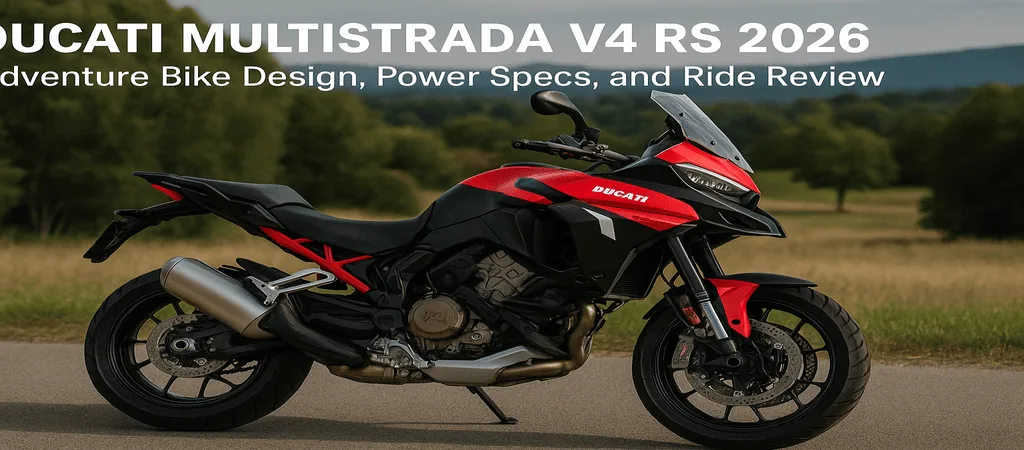
The design of the Multistrada V4 RS is a dramatic departure from the standard V4 model. Every element has been scrutinized for weight savings and performance enhancement.
Aerodynamic Aggression: The most striking feature is the new, sharper front fairing. It features larger, more pronounced winglets that are not just for show; they generate significant downforce at high speeds, improving front-end stability and braking performance. The LED headlight cluster is more compact, flanked by aggressive air intakes that feed the hungry 1103cc V4.
Lightweight Architecture: Carbon fiber is used extensively. The front fender, side panels, and even the rear subframe are crafted from this premium material to shave critical kilograms. The signature high front beak is shorter and more angular, improving aerodynamics and giving the bike a more hunkered-down, ready-to-pounce stance.
Ergonomics and Comfort: The riding position is a careful compromise. The handlebar is slightly lower and closer than the standard Multistrada, promoting a more sporty, engaged riding posture. However, it retains a reasonable seat-to-peg relationship to prevent fatigue on long journeys. The seat itself is a new, slimmer design but uses advanced multi-density foam for comfort.
Suspension and Wheels: The RS boasts top-shelf, semi-active electronic suspension from Öhlins, with Smart EC 2.0 technology. It automatically adjusts damping in real-time based on riding conditions, or can be manually configured for track or off-road use. It rolls on lightweight Marchesini forged aluminum wheels, shod with sport-touring tires as standard, with robust tubeless spoked wheels available as an option for serious off-road exploration.
Key Design & Feature Highlights:
-
Engine: Desmosedici Stradale V4 derived from Panigale V4 RS.
-
Frame: Enhanced aluminum front frame with carbon fiber subframe.
-
Bodywork: Aggressive fairing with functional aerodynamic winglets.
-
Materials: Extensive use of carbon fiber (fender, side panels, subframe).
-
Suspension: Öhlins Smart EC 2.0 semi-active electronic suspension.
-
Wheels: Lightweight Marchesini forged aluminum wheels.
Power Specs: The Heart of a Champion
This is where the Multistrada V4 RS truly separates itself from the entire adventure segment. By incorporating the engine from the Panigale V4 RS, it achieves a level of performance that was previously unimaginable for a bike of this type.
The 1103cc, 90-degree V4 engine features a counter-rotating crankshaft, a design trick borrowed from MotoGP that reduces gyroscopic inertia and makes the bike incredibly quick to change direction. The desmodromic valve system ensures precise valve control at extreme RPMs, a necessity for such a high-revving, high-output engine.
Estimated Performance Specifications:
| Specification | Detail |
|---|---|
| Engine Type | 1103cc, 90° V4, Desmodromic Valvetrain |
| Bore x Stroke | 81 mm x 53.5 mm |
| Max Power | 180 bhp (134 kW) @ 13,500 rpm (Estimated) |
| Max Torque | 85 lb-ft (115 Nm) @ 10,000 rpm (Estimated) |
| Compression Ratio | 14.8:1 |
| Transmission | 6-speed with Ducati Quick Shift (DQS) Up/Down EVO 3 |
| Final Drive | Chain |
The power delivery is managed by six sophisticated riding modes: Race, Sport, Touring, Urban, Enduro, and Wet. Each mode intricately controls engine character, throttle response, traction control (DTC EVO 3), wheelie control, engine braking (EBC EVO), and suspension settings. In “Race” mode, the full 180 bhp is available with a razor-sharp throttle. Switch to “Enduro,” and power is softened, and torque delivery is linearized to prevent rear wheel spin on loose surfaces.
Engine & Electronics Breakdown:
-
Desmodromic Valvetrain: Allows for higher RPM and more precise valve control than spring-activated systems.
-
Counter-Rotating Crankshaft: Dramatically improves agility and cornering stability.
-
Ducati Quick Shift (DQS) EVO 3: Enables seamless, clutchless upshifts and downshifts.
-
Cornering ABS EVO: Keeps the bike stable under hard braking, even when leaned over.
-
Ducati Wheelie Control (DWC) EVO: Manages front-end lift for acceleration control and safety.
-
Engine Brake Control (EBC) EVO: Allows the rider to adjust the level of engine braking.
On the Road and Off the Beaten Path: A Ride Review
Swinging a leg over the Multistrada V4 RS, the first impression is its surprisingly manageable feel. While the seat height is tall, the slimmer tank and carbon subframe make it feel less bulky than its specifications would suggest.
The Sportbike Incarnate: On a winding mountain road, the RS is nothing short of a revelation. The engine is a masterpiece. Below 6,000 rpm, it’s tractable and smooth, perfect for cruising. But crack the throttle open, and the V4 comes alive with a ferocious, linear power surge accompanied by an intoxicating, mechanical symphony from the underseat exhaust. The Öhlins suspension, in Sport mode, keeps the chassis planted and composed, even over mid-corner bumps. The level of feedback and front-end confidence is unparalleled in the adventure world.
The Touring Compromise: Is it comfortable? For a bike with such sporting intent, it’s surprisingly capable. The wind protection is excellent, and the seat, while firm, is well-shaped. The electronic suspension in “Touring” mode soaks up highway imperfections with ease. However, the more committed riding position means you’ll feel more wind pressure on your chest and more weight on your wrists over very long distances compared to a standard Multistrada or a BMW GS.
A Glimpse Off-Road: The RS is competent on well-maintained fire roads and gravel paths, especially in its dedicated “Enduro” mode. The suspension offers ample travel, and the softened power delivery prevents surprises. However, its true home is not technical, rocky single-track. The sport-oriented suspension tuning, the expensive forged wheels, and the extensive carbon fiber make it less suitable for hardcore off-roading where drops are likely. It’s an adventurer for those whose journey is 90% pavement, but who demand 100% capability to explore the remaining 10%.
Comparative Analysis at a Glance:
| Feature | Ducati Multistrada V4 RS (Est.) | BMW R 1250 GS Adventure | KTM 1290 Super Adventure R |
|---|---|---|---|
| Engine | 1103cc V4 | 1254cc Flat-Twin | 1301cc V-Twin |
| Power | 180 bhp | 136 bhp | 160 bhp |
| Weight (Kerb) | ~235 kg (Est.) | ~268 kg | ~238 kg |
| Primary Focus | Ultimate On-Road Performance | All-Round Capability & Comfort | Off-Road Prowess |
| Key Tech | Aero Winglets, Full Carbon Parts | Telelever Front Suspension | Adjustable Suspension & Rally Mode |
Ownership Considerations
Owning a machine like the Multistrada V4 RS is a commitment. The service intervals, typical of a high-strung, desmodromic engine, will be more frequent and costly than its rivals with simpler valve trains. Fuel consumption, while respectable on a steady cruise, will plummet when you tap into its performance. Furthermore, the extensive use of carbon fiber and premium components means that any repair after a tip-over will be significantly more expensive.
However, for the enthusiast who views these factors as part of the ownership experience of an exotic, no-compromise machine, there is simply no substitute.
Frequently Asked Questions (FAQs)
1. What is the expected price of the Ducati Multistrada V4 RS 2026?
The price is estimated to be significantly higher than the standard Multistrada V4, likely positioning it well into the premium super-adventure bracket.
2. How does the V4 RS engine differ from the standard V4 Granturismo?
The RS uses a higher-revving, more powerful Desmosedici Stradale engine with a different crankshaft and desmodromic valvetrain, unlike the Granturismo’s longer-stroke, spring-valve design focused on torque and service intervals.
3. Is the Multistrada V4 RS suitable for a beginner rider?
Absolutely not. Its immense power, sharp reflexes, and aggressive nature demand a high level of riding skill and responsibility.
4. Can you add luggage to the V4 RS?
Yes, Ducati will offer dedicated, lightweight side panniers designed to complement the bike’s sporty lines without affecting handling significantly.
5. What is the fuel tank capacity?
It is expected to have a slightly smaller tank than the standard model, around 18-19 liters, to save weight and maintain a narrow profile.
6. Does it have radar-assisted cruise control?
Yes, it is expected to feature the latest Ducati Radar System, offering adaptive cruise control and blind-spot detection for enhanced touring safety.
Conclusion
The Ducati Multistrada V4 RS 2026 is a breathtakingly ambitious machine. It successfully transplants the soul of a world-class superbike into a functional adventure chassis, creating an entirely new benchmark for on-road performance in this category. While its off-road capabilities are more limited than dedicated explorers and its ownership costs are steep, it stands alone as the ultimate hyper-adventure bike for the rider who values electrifying performance and cutting-edge technology above all else. It is not just a motorcycle; it is a statement.